

Some people leave the hospital, Some never leave your heart
Dr Amit Jain, Delhi
“मैं उनके सामने कमज़ोर नहीं पड़ सकता…”
A few days ago, a 76-year-old gentleman with advanced prostate cancer was admitted to our Palliative and End-of-Life Care Unit. He had been under our care before, but this time, the disease had won the battle against his body. The cancer had already spread to his lungs and liver. He came with jaundice, massive ascites, profound weakness, and eyes that silently told us what no investigation was needed to confirm. He was accompanied by his wife, who had probably spent decades standing beside him through every phase of life, and his son, who still believed that somehow his father would once again defeat the impossible. After examining him, I gently explained to the family that we had reached a stage where medicine could no longer cure him. Our goal now was not to prolong suffering but to ensure comfort, dignity, and peace. His son listened respectfully, but with moist eyes he said, “Doctor, my father has always come back stronger. Please don’t ask me to stop believing.”
Later that evening, I sat beside the patient. He looked at me with remarkable calmness. There was no fear in his eyes, only acceptance. In a faint voice, he smiled and said, “Doctor, I know… I don’t think I will survive this time.” There was a long silence between us. Then he slowly asked for a pen and a small piece of paper. His hands were trembling so much that every letter seemed like a struggle. It took him almost a minute to finish one sentence. He quietly handed the paper to me. On it, in shaky handwriting, were the words, “मैं उनके सामने कमज़ोर नहीं पड़ सकता…” I looked at him, and before I could say anything, he slowly turned his eyes toward his wife and son standing outside the room and whispered, “All my life… whenever there was a crisis, I stood in front of my family. They have only seen me fighting. If they see me weak today… everything I taught them will break.”
As a palliative care physician, I have heard countless last wishes, but that single sentence carried the weight of an entire lifetime.
Over the next two days, his condition continued to deteriorate. We kept preparing the family for what was coming, but acceptance often takes longer than understanding. His son continued asking if there was something more that could be done. Finally, I sat beside him and asked him a simple question: “Tell me honestly… what is stopping you from accepting this?” For the first time, he broke down completely. Through tears he said, “Doctor, years ago our business was taken away by my uncle. We lost everything. Everyone thought we were finished. But my father never cried in front of us. Every morning he would leave home with a smile and say, ‘Everything will be alright.’ He rebuilt our entire life with nothing but determination. Today, if I accept defeat before he does, how will I ever face him? He taught me to fight every battle. I just want him to know that his son has learned the same lesson.”
I quietly held his shoulder and replied, “Maybe today your father doesn’t need another warrior. Maybe today he simply needs his son.” Those words seemed to reach somewhere deep inside him. He walked back into the room, sat beside his father, and gently held his hand. There was a long silence between them, the kind of silence that says far more than words ever can. After a few moments, the old man slowly opened his eyes and whispered, “Business… sambhal lena…” His son nodded immediately, tears streaming down his face. “I promise, Papa.” A few minutes later, his father whispered again, “Maa ka dhyan rakhna…” Again, the son replied, “I promise.” Then, unable to control his emotions any longer, the son bent down, kissed his father’s forehead, and softly said, “Papa… you don’t have to be strong anymore. You have carried all of us your whole life. Now let us carry you.”
For the first time since his admission, I saw the old man’s eyes fill with tears. He gently squeezed his son’s hand. He didn’t say another word. He didn’t need to. In that silent squeeze was a father’s approval, his blessing, his gratitude, and perhaps his permission to finally let go. His wife sat beside him, softly reciting prayers while gently caressing his forehead. The room had become incredibly peaceful. There were no heroic interventions, no dramatic moments—only love, acceptance, and an unspoken understanding that this was goodbye. A few hours later, surrounded by the people he had lived his entire life for, he quietly took his last breath.
As I walked out of that room, I kept thinking about the little piece of paper still lying in my pocket. “मैं उनके सामने कमज़ोर नहीं पड़ सकता…” Perhaps that had been true for most of his life. But in his final moments, after hearing his son say, “Papa, you don’t have to be strong anymore,” he finally allowed himself to rest. Maybe the greatest achievement of that father’s life was not the business he rebuilt or the hardships he overcame. Maybe it was raising a son who had become strong enough to tell his father that it was finally okay… to let go.
As palliative care physicians, we often wonder whether we have done enough. But moments like these remind me that the most important medicine we can offer at the end of life is not another procedure or another drug. It is the opportunity for one last conversation, one last promise, one last touch, and one last chance to say, “I am here… and you can rest now.”
About the Author:
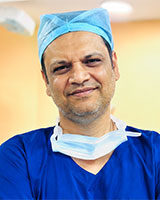
Dr. Amit Jain is the Head, Department of Pain and Palliative Care & Critical Care Medicine at Dharamshila Rahat Medical Centre, Delhi.
A trained Anaesthesiologist and Critical Care Specialist, Dr. Jain led the Medical ICU at Dharamshila Narayana Superspeciality Hospital, New Delhi, for ten years. His close encounters with critically ill individuals and witnessing the unmet palliative care needs of those admitted in the ICU inspired him to pursue formal training in Palliative Medicine. He subsequently completed the National Fellowship in Palliative Medicine (NFPM) from the Institute of Palliative Medicine, Kozhikode, and also holds a prestigious Clinical Fellowship in Pain Management from Aesculap Academy, Germany.
A passionate Palliative Care Physician, Dr. Jain has dedicated his career to supporting individuals receiving palliative care and their families in navigating the challenges of serious illness.